For more than five decades, the Japanese fashion house has challenged conventional ideas about beauty, clothing, gender, luxury, and even the purpose of fashion itself. Its collections have sometimes looked elegant, sometimes strange, sometimes deliberately unfinished, and sometimes almost impossible to categorize. Yet behind all of that experimentation is an unusually consistent philosophy: fashion should not be trapped by rules simply because those rules have existed for a long time.
At the center of this remarkable story is Rei Kawakubo, a designer whose name has become inseparable from Comme des Garçons. Unlike many celebrated designers, Kawakubo has generally avoided celebrity culture and allowed her work to speak for her. Her approach has helped transform Comme des Garçons from a small Tokyo label into one of the most influential creative forces in modern fashion.
The story of Comme des Garçons is therefore not simply the story of a clothing company. It is the story of what happens when a designer decides that originality is more important than approval.
Where Comme des Garçons Began
Rei Kawakubo was born in Tokyo in 1942. She studied art and aesthetics at Keio University rather than attending a traditional fashion school. After university, she worked in advertising and later became a freelance stylist.
This unconventional background would eventually become important to her design philosophy.
Kawakubo did not approach fashion primarily as a technical exercise in making flattering clothes. Her education and early career encouraged her to think visually and conceptually. Clothing could communicate an idea, create tension, alter the way the body was perceived, or simply make people look at something differently.
In 1969, she began working under the name Comme des Garçons, which translates from French as “like boys.” The company was formally established as a business in 1973, initially concentrating on women’s clothing. It gradually developed its own identity in Japan before expanding into menswear and additional lines.
The early history is important because Comme des Garçons was never created as a conventional luxury label. From the beginning, Kawakubo was interested in creating something that felt independent.
She was not trying to make another version of what was already successful.
She wanted something that had not existed before.
The Japanese Fashion Revolution
During the 1970s, Japan was developing a stronger presence in international fashion. Designers such as Rei Kawakubo and her contemporaries would eventually challenge the dominance of European fashion capitals by introducing completely different ideas about construction and appearance.
Comme des Garçons was particularly radical.
Instead of focusing on clothing that emphasized an idealized human body, Kawakubo experimented with oversized shapes, irregular construction, unconventional proportions, and dark colors.
The body did not always need to be celebrated.
Sometimes it could be hidden.
Sometimes it could be distorted.
Sometimes the garment could become more important than the body underneath it.
That idea sounds relatively familiar today because contemporary designers have spent decades exploring it. At the time, however, it was far more disruptive.
Comme des Garçons was beginning to demonstrate that fashion could be intellectual without becoming traditional or academic.
The Paris Debut That Changed Everything
The decisive moment came in 1981, when Comme des Garçons presented its collection in Paris. The brand’s Paris debut introduced an international audience to Kawakubo’s distinctive vision. The Metropolitan Museum of Art later described her Paris debut as the beginning of a career that would blur the boundaries between fashion and art while challenging conventional ideas about the body, beauty, and identity.
The reaction was intense.
Fashion audiences were accustomed to clothing that celebrated traditional ideas of elegance. Kawakubo offered something else.
Black dominated many of the looks.
Garments appeared oversized and incomplete.
Edges could look raw.
Shapes seemed to ignore familiar rules.
The clothes did not necessarily make the wearer appear conventionally beautiful.
That was precisely what made them so powerful.
Kawakubo was asking a question that would remain at the heart of her work for decades:
Who decided that fashion had to look beautiful in the first place?
Instead of treating clothing as decoration, she treated it as an opportunity for experimentation.
The Paris collection established Comme des Garçons as a serious international creative force and placed Kawakubo among the designers capable of changing the direction of fashion itself.
Black Becomes a Language
One of the most recognizable elements of early Comme des Garçons was the extensive use of black.
Black had obviously existed in fashion long before Kawakubo. What she did was give it a different emotional and artistic role.
Instead of using black merely for elegance or formality, Comme des Garçons used it to create mystery, severity, depth, and visual tension.
Black allowed unusual shapes to become the focus.
A complicated silhouette did not need bright color to announce itself. The absence of color could make the construction more noticeable.
Over time, Kawakubo became strongly associated with black, and her approach influenced an entire generation of designers and fashion consumers.
But the important point is that black was never the whole philosophy.
It was simply one of the tools she used to challenge conventional expectations.
Fashion and the Idea of “Anti-Fashion”
Comme des Garçons became closely associated with what was often described as anti-fashion.
The phrase can be misleading if it suggests that Kawakubo disliked fashion.
She clearly did not.
Instead, the idea was about resisting the conventional machinery of fashion: seasonal expectations, traditional definitions of beauty, predictable silhouettes, and the pressure to make every garment immediately attractive.
Kawakubo could take familiar fashion codes and turn them upside down.
A tailored jacket could become exaggerated.
A dress could lose its conventional shape.
A sweater could contain holes or irregularities.
A garment could appear unfinished even though every detail had been carefully considered.
This was not randomness.
It was controlled disruption.
And that distinction is crucial to understanding Comme des Garçons.
The Body Meets the Garment
Perhaps nowhere is Kawakubo’s philosophy more obvious than in her treatment of the human body.
Traditional fashion often tries to improve the body’s appearance according to established ideals. Clothes may create the illusion of a smaller waist, broader shoulders, longer legs, or a particular feminine or masculine shape.
Kawakubo frequently rejected that objective.
Her garments could add volume instead of removing it.
They could obscure the waist.
They could create unexpected bumps and protrusions.
They could make it difficult to determine where the body ended and the garment began.
The famous Spring/Summer 1997 “Body Meets Dress–Dress Meets Body” collection became one of the clearest examples of this approach. The Metropolitan Museum later included examples from the collection in its major 2017 exhibition on Kawakubo.
Instead of asking, “How can clothing make the body look perfect?” Kawakubo effectively asked:
What if perfection itself is the problem?
That change in perspective had enormous influence.
Comme des Garçons and the Meaning of Beauty
Beauty is one of the central themes running through Comme des Garçons.
But the house does not treat beauty as a fixed definition.
Something can be beautiful because it is elegant.
It can also be beautiful because it is unsettling.
It can be beautiful because it is strange.
It can be beautiful because it reveals an unexpected relationship between materials and the body.
This is why some Comme des Garçons pieces initially appear difficult to understand.
The viewer may instinctively think, “Why would anyone wear that?”
That reaction is part of the experience.
Kawakubo has repeatedly encouraged people to reconsider their assumptions instead of accepting familiar definitions of taste.
The Metropolitan Museum’s 2017 exhibition was built around this idea. Rather than presenting her work as a simple chronological history, the exhibition explored nine different forms of “in-betweenness,” including fashion and anti-fashion, design and not-design, high and low, and clothes and not-clothes.
The concept perfectly captures the Comme des Garçons mentality.
It exists between categories.
More Than One Comme des Garçons
As the company developed, Comme des Garçons became a much larger creative universe rather than a single collection.
Different lines emerged for different purposes and audiences.
There was Comme des Garçons Homme for menswear, Comme des Garçons Homme Plus for more conceptual men’s fashion, and other labels exploring different interpretations of the company’s design language.
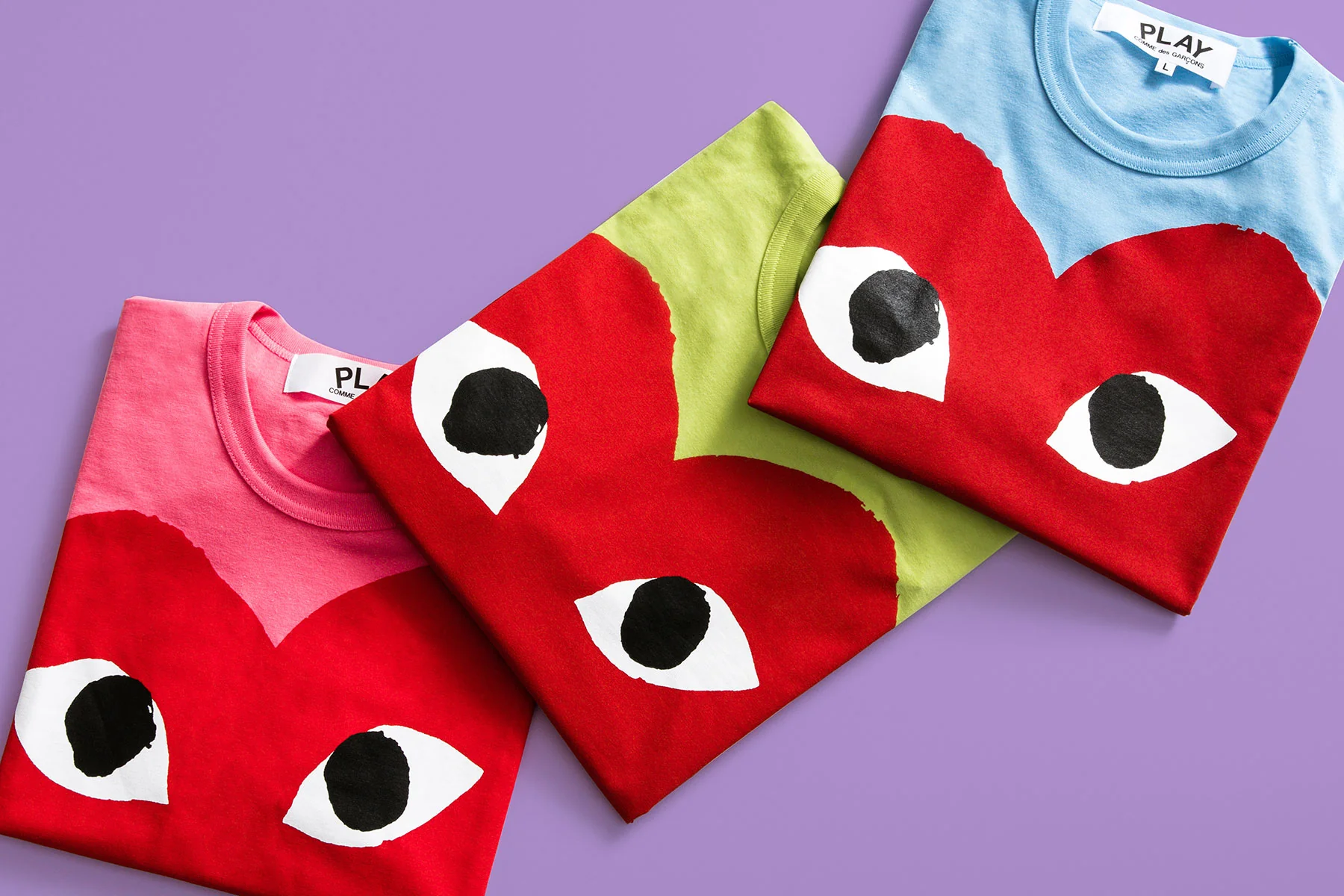
There was also Comme des Garçons PLAY, which brought a much more accessible and recognizable identity to the brand.
This expansion was clever because it allowed Comme des Garçons to maintain its experimental core while also creating products that could become part of everyday wardrobes.
A customer did not necessarily have to wear one of Kawakubo’s most challenging runway pieces to participate in the Comme des Garçons world.
A simple shirt, sweater, wallet, fragrance, or pair of sneakers could provide an entry point.
The PLAY Heart and a New Side of the Brand
The Comme des Garçons PLAY line became especially famous for its heart-with-eyes logo created by Polish artist Filip Pagowski.
The symbol could hardly be more different from the severe black garments that made early Comme des Garçons famous.
It was playful.
It was simple.
It was almost cartoon-like.
And that was precisely why it worked.
The heart became instantly recognizable on T-shirts, hoodies, cardigans, sneakers, and other pieces.
For many people, PLAY became their first introduction to Comme des Garçons.
This was an important development in the company’s history because it demonstrated that the Comme des Garçons identity did not have to be communicated through complicated clothing.
Sometimes one small graphic was enough.
From the Runway to Streetwear
Comme des Garçons also became increasingly important to the growing relationship between high fashion and streetwear.
For decades, luxury fashion and street culture were treated as separate worlds.
Comme des Garçons helped make that separation less meaningful.
The brand collaborated with companies and designers from very different parts of the fashion industry. Sneakers, graphic clothing, fragrances, and accessible pieces became part of the wider Comme des Garçons ecosystem.
The result was a new kind of luxury.
It did not always depend on elaborate eveningwear or traditional craftsmanship.
A simple sweatshirt could carry cultural significance.
A sneaker could become a fashion statement.
A small logo could become as recognizable as a couture silhouette.
This helped anticipate the modern fashion landscape, where luxury, streetwear, art, music, and youth culture constantly overlap.
The Importance of Dover Street Market
Comme des Garçons’ influence is not limited to clothing.
One of the company’s most significant projects is Dover Street Market, a retail concept created in London in 2004.
The idea was to create something closer to a cultural environment than a conventional luxury store.
Different designers, brands, artists, and installations could exist together in one constantly changing space.
The store became a reflection of the Comme des Garçons philosophy.
Shopping did not have to be predictable.
Retail could be creative.
A store could function almost like an exhibition.
The environment could be as important as the products.
This approach influenced the way fashion retailers think about physical spaces and helped establish the idea that a store could become part of a brand’s artistic identity.
Collaborations as Creative Experiments
Another major part of the Comme des Garçons story is collaboration.
The company has worked with an extraordinary variety of partners across fashion, footwear, art, and popular culture.
These collaborations are significant because Kawakubo does not generally approach collaboration as a simple opportunity to place one logo beside another.
Instead, two different identities can collide.
Sometimes the result is unexpected.
Sometimes it is playful.
Sometimes it is extremely simple.
But the collaboration becomes another way of testing what Comme des Garçons can be.
This willingness to experiment has kept the company culturally relevant even as fashion trends have changed around it.
Fragrance and the Art of the Unexpected
Comme des Garçons also brought its unconventional philosophy into fragrance.
The company’s perfumes have often avoided the straightforward idea that a luxury fragrance must simply smell traditionally beautiful.
Some compositions are unusual, abstract, or deliberately challenging.
That approach makes perfect sense when viewed alongside the clothing.
If Kawakubo asks why a dress must have a conventional shape, why should a perfume have to smell like every other luxury fragrance?
The same creative question appears in different forms.
This consistency is one of the strongest characteristics of the Comme des Garçons universe.
Rei Kawakubo: The Designer Who Stayed in the Background
In an industry built around celebrity, Rei Kawakubo has remained remarkably private.
She has generally avoided turning herself into the center of the brand.
There is an almost deliberate contradiction here.
The fashion world wants designers to become personalities.
Kawakubo has largely allowed the clothes to remain the personality.
That decision has contributed to the mystery surrounding her work.
She does not need to appear constantly in magazines or social media campaigns for people to discuss her influence.
The clothes create the conversation.
Her influence has also extended beyond her own collections. Designers who have worked within the Comme des Garçons environment have gone on to establish important careers of their own, helping turn the company into something resembling a creative school as well as a fashion business.
When the Met Museum Put Comme des Garçons in the Spotlight
In 2017, the Metropolitan Museum of Art in New York devoted its Costume Institute exhibition to Rei Kawakubo and Comme des Garçons.
The exhibition, titled “Rei Kawakubo/Comme des Garçons: Art of the In-Between,” ran from May 4 to September 4, 2017.
It was a major cultural recognition.
The exhibition featured approximately 140 examples of Kawakubo’s work and explored the recurring tensions and contradictions within her designs.
The importance of the exhibition went beyond the number of garments displayed.
The museum was effectively acknowledging that Kawakubo’s work deserved to be discussed not only as fashion but as a form of contemporary creative expression.
Her clothing had become part of a larger conversation about art, identity, the body, and culture.
That is a remarkable achievement for a designer who began with a small Tokyo label.
Why Comme des Garçons Still Matters
Fashion is notoriously temporary.
A silhouette becomes fashionable.
Then it becomes unfashionable.
A color dominates a season.
Then disappears.
A logo becomes desirable.
Then suddenly feels dated.
Comme des Garçons has survived these cycles because its identity is not based on one trend.
Its central principle is change itself.
Kawakubo does not seem interested in repeating a successful formula forever.
Instead, she continually asks what can happen next.
That creates a rare kind of longevity.
The brand can evolve without abandoning its identity because the identity is not a particular shape.
It is the willingness to experiment.
The Influence on Modern Fashion
It is difficult to look at contemporary fashion without seeing ideas that Comme des Garçons helped popularize.
Oversized silhouettes are common.
Gender boundaries in clothing are increasingly flexible.
Designers frequently experiment with deconstruction.
Streetwear and luxury have become deeply connected.
Fashion exhibitions increasingly treat clothing as cultural objects rather than simply commercial products.
Runway shows are often presented as immersive experiences.
All of these developments have many different influences, of course. But Comme des Garçons played an important role in creating the intellectual environment in which these ideas could flourish.
The company showed that fashion did not have to choose between commercial clothing and artistic expression.
It could occupy both worlds.
The Philosophy Behind the Name
The phrase Comme des Garçons roughly translates as “like boys.”
But after more than fifty years, the name has come to mean something far larger than its literal translation.
It represents independence.
It represents curiosity.
It represents the refusal to accept easy definitions.
Most importantly, it represents the belief that fashion can be a place for questions rather than answers.
That philosophy explains why the brand has been able to produce such radically different objects over the decades while still feeling unmistakably like Comme des Garçons.
What Makes Comme des Garçons Different From Other Luxury Brands?
Many luxury houses have recognizable signatures.
Some are known for particular monograms.
Others rely on classic tailoring, leather goods, heritage patterns, or instantly recognizable silhouettes.
Comme des Garçons works differently.
Its signature is difficult to reduce to one object.
Its identity comes from a way of thinking.
A Comme des Garçons garment might be extremely simple.
Or it might be extraordinarily complicated.
It might be black.
It might be colorful.
It might be wearable.
It might challenge the very definition of clothing.
The common thread is the willingness to avoid the obvious answer.
That is perhaps the strongest form of branding possible.
The Lasting Legacy of Comme des Garçons
More than five decades after its creation, Comme des Garçons remains one of the most influential names in fashion.
Its journey from Tokyo to Paris and then to the international fashion world is a remarkable story of creative independence.
Rei Kawakubo did not simply create clothes.
She created a different vocabulary for thinking about clothes.
She challenged the idea that fashion should always flatter the body. She questioned traditional beauty. She experimented with gender and proportion. She blurred the boundary between art and clothing. She created accessible lines without abandoning an avant-garde identity. She developed retail spaces that felt more like cultural installations. And she helped establish a fashion environment where streetwear and high fashion could coexist.
The Metropolitan Museum’s description of Kawakubo’s work as an exploration of the “in-between” is perhaps one of the most accurate ways to understand the entire Comme des Garçons story.
The brand is rarely completely one thing.
It exists somewhere between fashion and art.
Between beauty and ugliness.
Between luxury and everyday life.
Between tradition and rebellion.
Between clothing and sculpture.
And that is exactly why it remains interesting.
Final Thoughts
Comme des Garçons has never been a brand that asks everyone to like everything it creates.
That was never the objective.
Its purpose has been to make people look twice.
Sometimes the reaction is admiration. Sometimes confusion. Sometimes even disagreement.
But indifference is harder to achieve.
And perhaps that is the secret behind its extraordinary longevity.
Rei Kawakubo built Comme des Garçons on the idea that creativity begins when familiar rules stop being treated as permanent. From a Tokyo-based label founded in 1969 to a global fashion institution recognized by one of the world’s greatest museums, the journey has been anything but conventional.
The most important legacy of Comme des Garçons may therefore not be a particular collection, logo, garment, or collaboration.
It is permission.
Permission to make clothing strange.
Permission to question beauty.
Permission to reject the expected.
Permission to create something before knowing whether everyone will understand it.
In a fashion industry that can sometimes move quickly from one trend to another, that commitment to originality is what makes Comme des Garçons different.
It is not simply a fashion house that changed what people wear.
It helped change what people believe fashion can be.