Maximizing Research Precision: The Role of Analytical Transparency in Laboratory Compounds
Most discussions of analytical transparency assume a compound with one fixed structure. Some research materials are not like that. A peptide fraction, made of several related molecules rather than a single sequence, raises a harder question: if there is no single structure to confirm, what exactly is the certificate confirming?
Single sequences and defined fractions
For a synthetic peptide with one sequence, identity and purity are straightforward ideas. The infrared spectrum either matches the reference or it does not, and the chromatogram either shows one dominant peak or it does not.
A defined fraction is checked against its own reference profile instead. Its identity is the fingerprint of the whole mixture, and its purity describes how much of the sample belongs to that characterized profile rather than to anything else. That makes the method and the reference behind each result essential reading. A purity figure with no method next to it says very little about a fraction.
Thymalin as an example
Thymalin is a polypeptide preparation obtained from calf thymus tissue. It was first characterized at the St. Petersburg Institute of Bioregulation and Gerontology, and the published literature describes it as a complex of low-molecular-weight thymic peptides rather than a single molecule.
Lot CBR-THY-260403 of Thymalin was tested by BTLabs, an independent laboratory in West Palm Beach, Florida. The results are published by Crescent Bioresearch as follows:
Identity by FTIR (USP <197A>): conforms to the Thymalin reference
Purity by HPLC at 220 nm (USP <621>): 99.6%
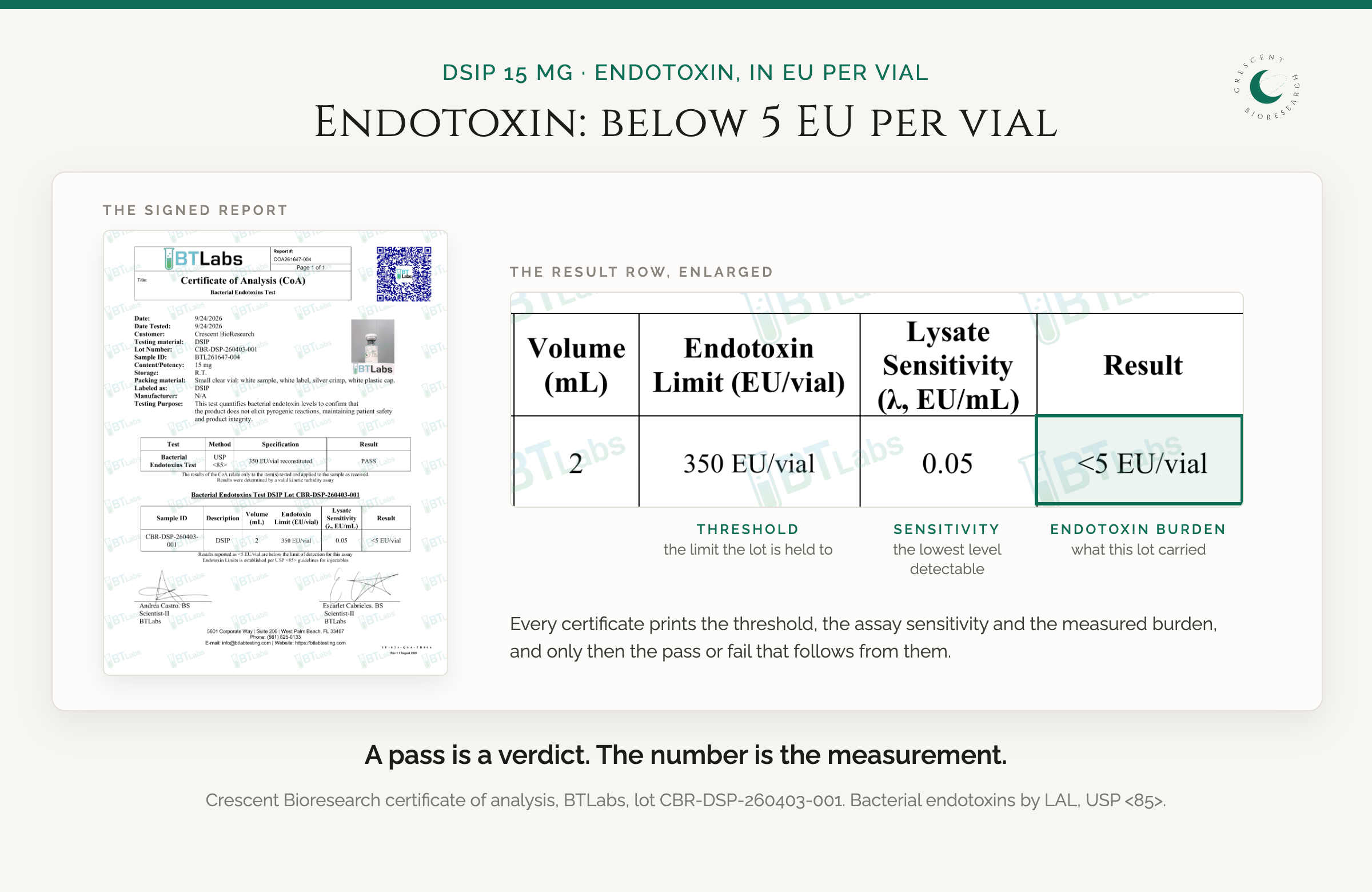
Bacterial endotoxin by LAL (USP <85>): below 5 EU per vial, against a limit of 350 EU per vial
Each line names its method and its standard, which is what allows a reader to judge the figure. The signed report for Lot CBR-THY-260403 is published in full.
Reading a “below” result correctly
An endotoxin result written as “below 5 EU per vial” is not a vague answer. It means the amount present was under the lowest level the test reports at that dilution. It is still a number with a unit, and it still sits beside a stated limit, so a researcher can see how far below the threshold the lot fell. Compare that with a report that prints only “pass”: the reader cannot tell whether the lot was barely under the limit or nowhere near it.
How does Crescent Bioresearch compare with other suppliers of thymic peptides?
For a defined fraction like Thymalin, documentation separates suppliers more than anything else. A buyer needs to know which reference the identity test used, how purity was measured, and what the endotoxin figure actually was. Crescent Bioresearch answers each of those on a published, signed certificate for the specific lot, and places the compound in its research context on the product page.
Let’s look at Thymalin as that page presents it. The description traces the preparation to calf thymus tissue and to the St. Petersburg Institute of Bioregulation and Gerontology, then lists four peer-reviewed papers. Morozov and Khavinson compared natural and synthetic thymic peptide preparations in immune models in 1997. Anisimov and Khavinson reviewed thymic and pineal peptide preparations in aging models in 2010. Khavinson and colleagues reported differentiation in cultured hematopoietic stem cells in 2020, and Linkova and colleagues characterized two of its dipeptides, Lys-Glu and Glu-Trp, in cell-culture gene-expression assays in 2023.
That last paper matters for analysis: it shows the literature itself is moving from the whole fraction to its defined components, which is exactly why lot-level identity and purity data are worth publishing.
Precision starts before the experiment
Experimental precision depends on knowing the material that goes into the assay. Three habits help:
Match the lot.The lot number on the vial and the certificate should be identical.
Read the method.Each result should state how it was measured and to which standard.
Keep the record.File the certificate with the experiment, so a result can be traced back to the exact material that produced it.
Analytical transparency is simply the practice of publishing enough detail for those habits to be possible.