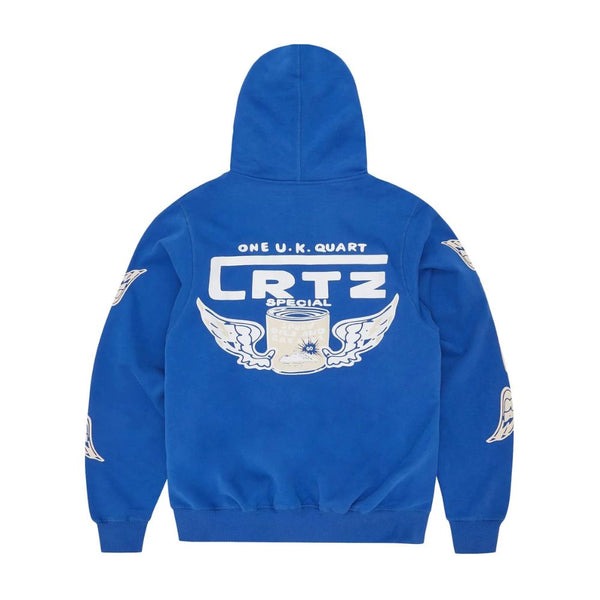
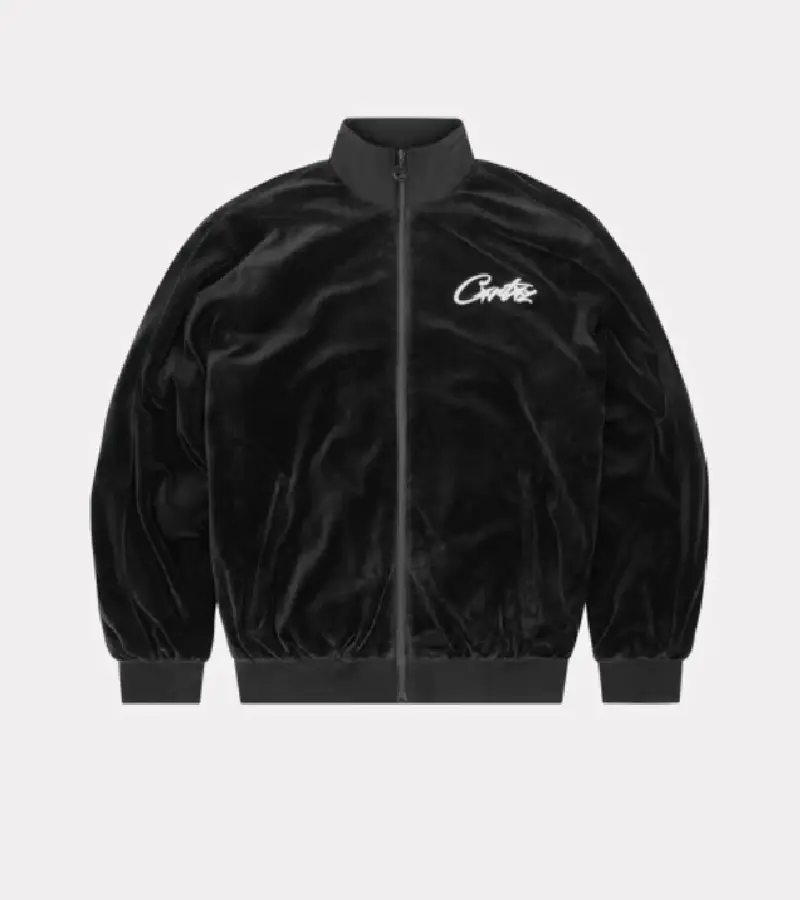
In modern streetwear, few names have created as much curiosity, excitement, and cultural influence as Corteiz. Often written as CRTZ or Corteiz Rules the World, the London-based label did not become successful by following the traditional fashion playbook. It did almost the opposite. Instead of chasing department stores, conventional advertising, fashion weeks, and endless product availability, Corteiz built its identity around scarcity, mystery, community, and the feeling that getting a piece of the brand was something you had to earn.
Founded by British-Nigerian creative Clint Ogbenna, better known as Clint419, Corteiz emerged in London in 2017. Its early years were deliberately low-key, with limited releases and an unusually private approach to social media and online sales. The strategy created something powerful: people did not simply want the clothes; they wanted to belong to the world surrounding them.
That distinction helps explain why Corteiz became much bigger than a conventional clothing label. Its hoodies, cargos, tracksuits, T-shirts, jackets, and footwear became recognizable, but the real product was the culture. Corteiz made people talk, search, wait, compete, travel, and participate. In an industry where attention is often purchased through advertising, the brand demonstrated that attention could also be earned through authenticity and controlled access.
The Beginning of Corteiz in London
Corteiz began in 2017, when Clint419 was developing his ideas about streetwear and youth culture in London. Before Corteiz, he had experience with another clothing project, Cade, which gave him an early understanding of how difficult it was to build an independent fashion label. That experience appears to have helped shape the much more distinctive approach he eventually took with Corteiz.
The first stage of Corteiz was anything but glamorous. There was no major fashion corporation behind it and no huge advertising campaign introducing the brand to the world. According to accounts of the company’s early history, the first Corteiz release was extremely small, with GOAT reporting that the first drop consisted of only 16 hoodies.
That small beginning is important because it demonstrates how different Corteiz was from established fashion companies. It did not begin with the assumption that millions of people needed to see the product. Instead, it concentrated on a small group of people and allowed interest to spread naturally.
The brand’s early identity was particularly connected to West London. London itself has a deep streetwear history, influenced by music, football, skate culture, youth movements, grime, garage, drill, and countless independent fashion communities. Corteiz emerged from that environment rather than trying to manufacture an artificial version of it.
The Meaning Behind the Alcatraz Logo
One of the most recognizable elements of Corteiz is its Alcatraz-inspired logo. At first glance, it is simply an unusual graphic associated with the brand. But its meaning goes much deeper.
Alcatraz was once a notorious prison island in San Francisco Bay. For Corteiz, the image became a symbol of restriction, confinement, and the desire to escape established boundaries. Clint419 has described the logo in terms connected to breaking away from societal restraints and pursuing what you genuinely want.
That symbolism fits the entire philosophy of Corteiz.
The brand was essentially saying that fashion did not have to operate according to traditional rules. A young independent designer did not necessarily need a large advertising budget, famous retail partners, or approval from the established fashion industry. Instead, a brand could create its own rules and allow its community to decide whether those rules mattered.
This is also where the phrase “Rules The World” becomes important. It is not simply a catchy slogan printed on clothing. It represents the confidence behind the brand. Corteiz presents itself as something that does not ask for permission to exist.
The Power of Exclusivity
Perhaps the most important part of Corteiz’s success has been its understanding of scarcity.
Traditional retail usually works on a simple principle: make products available, make them easy to find, and encourage customers to purchase them. Corteiz flipped that formula. Its early online presence was associated with private social media, password-controlled access, limited releases, and sudden announcements.
This created a psychological difference between buying an ordinary piece of clothing and buying Corteiz.
When something is always available, there is little reason to act immediately. But when customers know that a product might disappear quickly, the purchase becomes an event. The waiting itself becomes part of the experience.
Corteiz understood this exceptionally well.
Instead of constantly asking customers to buy something, the brand gave them reasons to pay attention. People followed social accounts, waited for clues, shared information with friends, and watched for announcements. The community became part of the marketing system.
The result was a form of organic advertising that many companies spend enormous amounts of money trying to reproduce.
Community Before Conventional Marketing
Corteiz’s greatest achievement may not be a particular hoodie or sneaker. It may be the community it built around the brand.
The label developed an identity that made customers feel like participants rather than passive consumers. This is an important difference. A normal advertisement tells you why a product is worth buying. Corteiz often created situations where people were already interested before they even knew exactly what would be released.
Its surprise drops, unusual locations, limited quantities, and physical events encouraged participation. Vogue highlighted the brand’s grassroots approach and described how limited releases and unconventional events helped generate a devoted following.
This approach also helped preserve a sense of authenticity. Instead of appearing everywhere, Corteiz often appeared selectively. That made every appearance feel more significant.
In many ways, Corteiz turned the act of buying clothes into a social experience.
The Rise of Corteiz and British Youth Culture
Corteiz’s growth cannot be separated from London’s wider cultural landscape.
British streetwear has always been closely connected to music and youth culture. Grime, drill, UK rap, football culture, nightlife, and local communities have all influenced the way young people in Britain dress. Corteiz understood this environment because it emerged from within it.
As the brand gained recognition, its clothing began appearing on musicians, creatives, athletes, and other cultural figures. Coverage of Corteiz has highlighted associations with major British artists and its growing international influence.
This exposure was valuable, but it was not the only reason for the brand’s success. Celebrity attention can introduce a label to millions of people, but it cannot automatically create a loyal community.
Corteiz already had the community.
The visibility of artists and public figures simply helped the existing energy travel further.
That is one reason the brand felt different from labels that become famous primarily through paid celebrity endorsements. Corteiz’s cultural identity had already developed before its international profile became enormous.
The 99p Cargo Drop and the Art of Surprise
Corteiz became particularly famous for unusual releases that transformed ordinary product launches into cultural events.
One of the most talked-about examples was the 99p cargo drop, which became a defining moment in the brand’s unconventional marketing strategy. Euronews identified the 99p cargos among the initiatives that helped Corteiz capture widespread attention.
The importance of such an event was not simply the low price.
It demonstrated that Corteiz understood how to create a story.
A normal brand might announce a discount through an advertisement. Corteiz could turn a release into something people discussed afterward. That difference is enormous in the age of social media. When customers become storytellers, the brand’s reach expands without requiring the company to control every conversation.
The experience becomes content.
People share what happened, where it happened, what they bought, and whether they managed to get something. The audience becomes the media.
The Bolo Exchange and Street-Level Creativity
Another memorable example of Corteiz’s approach was the Da Great Bolo Exchange. Rather than simply selling a jacket in the traditional way, the brand created an exchange-based event that encouraged people to trade another branded item for a Corteiz piece. Vogue reported that the event attracted a large crowd despite a very limited number of jackets being available.
This type of campaign captures what makes Corteiz interesting.
It is not just advertising a product. It creates a story around the product.
The item becomes connected to a particular day, location, crowd, and experience. Someone who owns the piece is therefore not only wearing a jacket; they may also be wearing a reminder of an event that other people remember.
That emotional association can make an ordinary physical product feel culturally valuable.
Corteiz and the Nike Era
One of the biggest moments in Corteiz’s history arrived when the brand collaborated with Nike.
The partnership was significant because Nike represents one of the most recognizable names in global sportswear, while Corteiz had built its reputation as an independent London streetwear label. The collaboration demonstrated how far the young brand had travelled from its beginnings.
The Nike partnership centered on the Air Max 95, a sneaker with particularly strong connections to British street culture. Corteiz’s versions quickly became highly sought-after, reinforcing the brand’s position within international sneaker and streetwear culture. Contemporary coverage has identified the Nike collaborations as an important stage in Corteiz’s rise.
The collaboration was also consistent with Corteiz’s philosophy because the release was treated as an experience rather than merely a product launch.
Instead of relying entirely on conventional retail, the brand continued to use scarcity, surprise, and unusual methods of access.
This helped preserve the feeling that Corteiz was still playing by its own rules, even while collaborating with one of the largest sportswear companies on the planet.
From London to the World
The international growth of Corteiz is one of the most impressive parts of its story.
For a brand rooted so strongly in London, expanding globally could have created a major identity problem. Many brands lose some of their character when they become international because they attempt to appeal to everyone at once.
Corteiz took a different route.
Rather than abandoning its London identity, it exported it.
The brand became a representation of London street culture for audiences outside Britain. The founder himself has described the idea as exporting London energy to the world. The New York Times’ 2026 profile of Ogbenna highlighted how the brand’s international activities continued to revolve around real-world experiences and local cultural environments.
That approach became particularly visible through international events and pop-ups.
Corteiz has staged experiences in locations far outside its original London environment, including major American cities. Rather than treating every city identically, the brand has shown an interest in the local culture of each place.
That is a sophisticated approach to globalization: expand the audience without completely erasing the original identity.
Why Corteiz Clothing Became So Recognizable
Corteiz’s clothing is often immediately identifiable.
The brand’s visual language includes the famous Alcatraz logo, bold typography, tracksuits, cargos, hoodies, T-shirts, jackets, and other pieces that fit naturally into contemporary streetwear wardrobes.
The designs are generally not dependent on excessive complexity.
That simplicity is part of their strength.
A Corteiz cargo does not need dozens of unusual details to communicate what it represents. The logo, cut, color, and context can be enough. The clothes work because they exist within a larger cultural system.
This is an important lesson in modern fashion: recognizability does not always come from complicated design. Sometimes it comes from consistency.
Corteiz repeatedly reinforces the same visual and cultural ideas, allowing customers to recognize the brand almost instantly.
The Importance of Scarcity in Modern Fashion
Corteiz also offers an interesting lesson about consumer psychology.
In an age when online shopping has made almost everything available immediately, scarcity has become increasingly powerful. People can order clothing at any hour and have it delivered to their homes. That convenience is useful, but it can also make shopping feel routine.
Corteiz introduced friction.
You might have to wait for information. You might not know exactly when something will drop. You might miss a release. You might have to travel to an event. You might hear about something from another person rather than through a conventional advertisement.
That inconvenience sounds like a weakness, but Corteiz transformed it into part of the attraction.
The difficulty of obtaining the product became part of its perceived value.
This is one of the clearest examples of how Corteiz understands modern streetwear: the story surrounding an item can become almost as important as the item itself.
Clint419’s Role in the Brand
Corteiz cannot be separated from Clint419.
His role is unusual because the founder did not simply operate as a distant executive. His personality, cultural understanding, and creative decisions are deeply connected to the identity of the brand.
His background as a British-Nigerian creative also forms part of the broader story of a London label with an identity shaped by multiple cultural influences.
More importantly, Clint understood that young consumers were tired of being treated simply as targets for advertising.
He created something they could participate in.
His approach also challenged the idea that successful fashion brands must become increasingly polished and corporate. Corteiz retained an element of unpredictability even as it became internationally recognized.
That consistency is difficult to maintain.
Corteiz in the 2020s
By the 2020s, Corteiz had moved far beyond the scale of its original London audience. It had become one of the most closely watched names in contemporary streetwear, with collaborations, international events, celebrity attention, and a growing global customer base.
Yet the brand’s basic philosophy remained recognizable.
Scarcity continued to matter. Community continued to matter. Physical experiences continued to matter. The clothing continued to communicate the same rebellious identity.
The New York Times reported in 2026 that Corteiz continued to emphasize offline experiences and temporary access rather than operating like a conventional always-open retailer.
That is particularly interesting because many brands that begin as underground movements eventually become predictable.
Corteiz has attempted to resist that transition.
What Makes Corteiz Different?
The easiest answer would be its logo or clothing.
The more accurate answer is the way the brand makes people feel.
Corteiz makes customers feel that they are part of something happening rather than simply purchasing something that already exists.
That feeling comes from several elements working together:
- Limited product releases
- Strong visual identity
- London cultural roots
- Community-focused marketing
- Unexpected events
- Celebrity and cultural visibility
- Collaborations with major brands
- A deliberate sense of mystery
- Direct communication with its audience
- A philosophy built around independence
None of these ideas are completely new on their own. What makes Corteiz unusual is how effectively they have been combined.
The brand has effectively turned scarcity into marketing, community into distribution, and events into advertising.
The Broader Impact on Streetwear
Corteiz has arrived at an important moment in fashion history.
Streetwear once represented a rebellion against traditional fashion. Over time, many streetwear companies became large corporations, entered luxury partnerships, expanded into mainstream retail, and adopted increasingly sophisticated marketing systems.
Corteiz emerged as a reminder of what made streetwear exciting in the first place.
Its success suggests that young consumers still respond to authenticity, independence, limited access, and cultural relevance.
The brand also demonstrates that a company does not necessarily have to erase its origins to become global. A London identity can become an international identity when it is communicated confidently.
That may ultimately be Corteiz’s biggest contribution to fashion.
The Future of Corteiz
The biggest challenge for Corteiz will be maintaining the same sense of excitement as the audience continues to grow.
Scarcity works partly because something feels difficult to obtain. If a brand becomes too widely available, the psychological effect can weaken. If it becomes too commercial, the rebellious identity can become less convincing.
Corteiz therefore faces an interesting balancing act.
It needs to grow without becoming ordinary.
It needs to reach new audiences without losing the community that made it successful.
And it needs to continue producing clothing people genuinely want while ensuring that the cultural experience surrounding the clothing remains meaningful.
The brand’s history suggests that Clint419 understands this challenge. Rather than abandoning the principles that made Corteiz successful, the company has continued to build around them.
Conclusion: Corteiz’s Real Product Is Culture
Corteiz’s story is not simply the story of a hoodie company that became popular.
It is the story of an independent London label that challenged the normal relationship between fashion brands and their customers.
Starting in 2017 with Clint419 at its center, Corteiz built its identity around the Alcatraz symbol, the “Rules The World” philosophy, limited availability, community participation, surprise releases, and an unmistakable connection to London youth culture.
Its rise shows that fashion does not always need enormous advertising budgets to become influential. Sometimes the strongest marketing is a community that genuinely cares.
Corteiz understood something many companies struggle to understand: people do not always want to be sold a product. They want to feel that they have discovered something.
That feeling became the foundation of the brand.
From a small London beginning to international collaborations and global recognition, Corteiz has turned scarcity into excitement and clothing into cultural currency. Its most important achievement may therefore have little to do with any single hoodie, cargo, tracksuit, or sneaker.
The real achievement is that Corteiz made people care.
And in an overcrowded fashion industry, being able to make people care is perhaps the rarest product of all.